MARRIAGE, RELATIONSHIPS & PO
At the end of this UNIT you should know the following:
- Know about gender roles in the domestic division of labour.
- Know about power relationships between couples, including decision-making, control: of resources domestic violence.
- Be able to analyse how far these roles and relationships have changed over time.
- Be able to evaluate different sociological views on couples’ roles and relationships.
COUPLES
In the 19th century, the Victorian family was very patriarchal - that is, the man was in every sense the head of the household. For example, on marrying, a woman’s property became her husband’s. Similarly, grounds for divorce .vere very unequal - a man could gain a divorce on the grounds of his wife’s adultery, but a woman had to prove ’er husband’s cruelty or another ‘matrimonial offence’ in addition to adultery.
This Topic is about married and cohabiting couples. It looks at equality and inequality in families and households.
Sociologists are interested in how far couples have a more equal relationship today. Some of the key questions they ask about couples are:
- Do men and women share housework and childcare equally?
- Do men and women have an equal say in family decisions and do they get equal shares of the household’s income?
- Why does domestic violence occur and who commits it?
The domestic division of labour
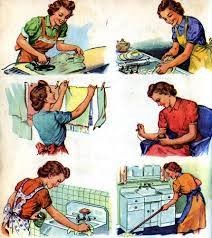
The domestic division of labour refers to the roles that men and women play in relation to housework, childcare and paid work. Sociologists are interested in whether men and /women share domestic tasks equally.
Parsons: instrumental and expressive roles
In the traditional nuclear family, the roles of husbands and wives are segregated - separate and distinct from one another. In Talcott Parsons’ (1955) functionalist model of the family, for example, there is a clear division of labour ‘between spouses:
- The husband has an instrumental role, geared towards achieving success at work so that he can provide for the family financially. He is the breadwinner.
- The wife has an expressive role, geared towards primary socialisation of the children and meeting the family’s emotional needs. She is the homemaker, a fulltime housewife rather than a wage earner.
Parsons argues that this division of labour is based on biological differences, with women ‘naturally’ suited to the nurturing role and men to that of provider. He claims that this division of labour is beneficial to both men and women, to their children and to wider society. Some conservative thinkers and politicians, known as the New Right, also hold this view.
However, other sociologists have criticised Parsons:
- Michael Young and Peter Willmott (1962) argue that men are now taking a greater share of domestic tasks and more wives are becoming wage earners.
- Feminist sociologists reject Parsons’ view that the division of labour is natural. In addition, they argue that it only benefits men. Can you tell me who says this?
Joint and segregated conjugal roles
Elizabeth Bott (1957) distinguishes between two types of conjugal roles; that is, roles within marriage:
- Segregated conjugal roles, where the couple have separate roles: a male breadwinner and a female homemaker/carer, as in Parsons’ instrumental and expressive roles. Their leisure activities also tend to
be separate.
- Joint conjugal roles, where the couple share tasks such as housework and childcare and spend their leisure time together.
Remember the FUNCTIONALISTS …YOUNG & WILLMOTT?
Go back to your Functionalism notes as there is some more information there too.
Young and Willmott identified a pattern of segregated conjugal roles in their study of traditional working-class extended families in Bethnal Green, east London, in the 1950s. Men were the breadwinners. They played little part in home life and spent their leisure time with workmates in pubs and working men’s clubs. Women were full-time housewives with sole responsibility for housework and childcare, helped by their female relatives. The limited leisure women had was also spent with female kin.
The symmetrical family & THE MARCH OF PROGRESS:
Young and Willmott (1973) take a ‘march of progress’ view of the history of the family. They see family life as gradually improving for all its members, becoming more equal and democratic. They argue that there has been a long-term trend away from segregated conjugal roles and towards joint conjugal roles and the ‘symmetrical family.
By the symmetrical family they mean one in which the roles of husbands and wives, although not identical, are now much more similar:
- Women now go out to work, although this may be part- time rather than full-time.
- Men now help with housework and childcare.
- Couples now spend their leisure time together instead of separately with workmates or female relatives.
In their study of families in London, Young and Willmott found that the symmetrical family was more common among younger couples, those who are geographically and socially isolated, and the more affluent (better off). Young and Wilmott see the rise of the symmetrical nuclear family as the result of major social changes that have taken place during the past century:
- Changes in women’s position, including married women going out to work
- Geographical mobility - more couples living away from the communities in which they grew up
- New technology and labour-saving devices
- Higher standards of living.
Many of these factors are inter-linked. For example, married women bringing a second wage into the home raises the family’s standard of living. This means the couple can afford more labour-saving devices. This makes housework easier and encourages men to do more.
Application task:
Explain how geographical mobility might help to give rise to symmetrical families.
A feminist view of housework
Feminist sociologists reject this ‘march of progress’ view. They argue that little has changed: men and women remain unequal within the family and women still do most of the housework. They see this inequality as stemming from the fact that the family and society are male-dominated or patriarchal. Women occupy a subordinate and dependent role within the family and in wider society.
Remember in Sociology we don’t just say “Feminist Sociologists say…” We give examples of what they say. This is your EVIDENCE in the exam. So can you write down a paragraph about what certain feminists (Radical/Liberal/Marxist) say about the family?
The feminist Ann Oakley (1974) criticises Young and Willmott’s view that the family is now symmetrical. She argues that their claims are exaggerated. Although Young and Willmott found that most of the husbands they interviewed ‘helped’ their wives at least once a week, this could include simply taking the children for a walk or - making breakfast on one occasion. For Oakley, this is hardly convincing evidence of symmetry.
In her own research on housewives, Oakley found some evidence of husbands helping in the home but no evidence of a trend towards symmetry. Only 15% of husbands had a! high level of participation in housework, and only 25%j|^|j a high level of participation in childcare.
Husbands were more likely to share in childcare than in housework, but only its more pleasurable aspects. Most couples defined the father’s role as one of ‘taking an interest’. A good father was one who would play with the children in the evenings and ‘take them off her hands’ on Sunday morning. However, this could mean that mothers if lost the rewards of childcare, such as playing with the children, and were simply left with more time for housework. –
Later research supports Oakley’s findings. Mary Boulton (1983) found that fewer than 20% of husbands had a ’A major role in childcare’. She argues that Young and Willmott exaggerate men’s contribution by looking at the tasks involved in childcare rather than the responsibilities. A father might help with specific tasks, but it was almost always the mother who was responsible for the child’s security and well-being.
Similarly, research in the 1990s by Alan Warde and Kevin Hetherington (1993) found that sex-typing of domestic tasks remained strong. For example, wives were 30 times more likely to be the last person to have done the washing, while husbands were four times more likely to be the last person to wash the car.
In general, Warde and Hetherington found that men would only carry out routine ‘female’ tasks when their partners were not around to do them. Nevertheless, they did find evidence of a slight change of attitude among younger men. They no longer assumed that women should do the housework, and were more likely to think they were doing less than their fair share.
Analysis and Evaluation Task:
What problems might there be in trying to research how much housework people do?
Are couples becoming more equal?
The impact of paid work
Most of the women in Oakley’s study in the 1970s were full-time housewives, but today many more wives go out to work, either full-time or part-time. This trend towards both partners working raises two questions:
- Is it leading to a more equal division of domestic tasks, with a ‘new man’ taking responsibility and doing an equal share of the housework and childcare? This is a march of if’, progress view.
- Or does it simply mean that women now have to carry a ‘dual burden’ of paid work as well as domestic work?
This is a feminist view.
The March of Progress View
Like Young and Willmott’s symmetrical family described earlier, some recent sociologists take an optimistic view. They argue that women going out to work is leading to a more equal division of labour at home. In this march of progress view, men are becoming more involved in housework and childcare just as women are becoming more involved in paid work outside the home.
For example, Jonathan Gershuny (1994) argues that women Working full-time is leading to a more equal division of labour in the home. Using time studies, he found that these women did less domestic work than other women.
Similarly, Oriel Sullivan’s (2000) analysis of nationally representative data collected in 1975, 1987 and 1997 found a trend towards women doing a smaller share of the domestic work and men doing more. (Please see the table below). Her analysis also showed an increase in the number of couples with an equal division of labour and that men were participating more in traditional ‘women’s’ tasks.
Women’s percentage share of domestic work, by employment status of partners, Great Britain
| 1975 | 1987 | 1997 | |
| Husband full-time, wife full-time | 68 | 62 | 60 |
| Husband full time, wife part-time | 80 | 70 | 69 |
| Husband full time, wife not employed | 82 | 73 | 73 |
| All | 77 | 67 | 63 |
Source: adapted from Sullivan (2000)
These trends reflect changes in attitudes to the traditional division of labour. For example, the British Social Attitudes survey (2013) found a fall in the number of people who think it is the man’s job to earn money and the Woman’s job to look after home and family. In 1984, 45% of men and 41 % of women agreed with this view, but by 2012 only 13% of men and 12% of women agreed.
The Feminist View
In the view of feminist sociologists, women going into paid work has not led to greater equality in the division of domestic labour. There is still little sign of the ‘new man’ who does an equal share of housework and childcare, while women now carry a dual burden, as the following evidence from the British Social Attitudes survey shows
Once again, find an example of a feminist who actually says this? EVIDENCE.
Problems with Surveys:
Another problem with such surveys is that they often focus only on easily quantifiable aspects such as who performs which tasks or how much time they spend doing them. What surveys don’t do is give us important detail.
Taking responsibility for children
While useful, statistics tell us nothing about who takes responsibility for ensuring that the tasks are done. As we saw earlier, Boulton (1983) points out that although fathers may help by performing specific childcare tasks, it is usually the mother who takes responsibility for the child’s security and well-being.
Boulton’s view is supported by a number of studies:
- Ferri and Smith (1996) found that fathers took responsibility for childcare in fewer than 4% of families.
- Dex and Ward (2007) found that, although fathers had quite high levels of involvement with their three-year-olds (for example, 78% played with their children), when it came to caring for a sick child, only 1 % of fathers took the main responsibility.
- Braun, Vincent and Ball (2011) found that in only three families out of 70 studied was the father the main carer. Most were ‘background fathers’; helping with childcare was more about their relationship with their partner than their responsibility towards their children. Most fathers held a ‘provider ideology’ that their role was as breadwinners, while the mothers saw themselves as the primary carers. This was underpinned by ideas about ‘intensive mothering’ in the media telling women how to be good mothers.
These findings are in some ways very similar to those of Oakley four decades earlier. Write a paragraph on how these findings resonate with what Oakley discovered.
“Emotion work” and the “Triple Shift”
Another aspect of taking responsibility for other family members is what Arlie Russell Hochschild (2013) calls ’emotion work’. Feminists have noted that women are often required to perf orm emotion work, where they are responsible for managing the emotions and feelings of family members, such as handling jealousies and squabbles between siblings, ensuring everyone is kept happy and so on, while at the same time exercising control over their own emotions. Jean Duncombe and Dennis Marsden (1995) argue that women have to perform a ‘triple shift’ of housework, paid work and emotion work.
Dale Southerton (2011): Taking responsibility for ‘quality time’
Another responsibility is that of coordinating, scheduling and managing the family’s ‘quality time’ together – a responsibility that usually falls to mothers.
This has become more difficult in today’s late modern society with recent social changes such as the emergence of the 24/7 society and flexible working patterns. These changes have led to people’s time being more fragmented and ‘de-routinised’. As Southerton argues:
‘Achieving quality time is becoming more and more difficult as working mothers find themselves increasingly juggling the demands of work and career, personal leisure time and family, while at the same time managing and coordinating their own and their families’ social activities.’
How do we measure being ‘pushed for time’? This is impossible to comment on in these surveys. This then gives us inaccurate results as to the reality of life in families today.
Southerton also notes that, although some studies now show that men and women have more or less equal amounts of leisure time, they have different experiences of it. For example, men are more likely to experience consolidated ‘blocks’ of uninterrupted leisure time, whereas women’s leisure is often punctuated by child care. Women are also more likely to multi-task than men. This indicates that women are carrying a dual burden in which they face an increased volume of activities to be managed.
Analysis and Evaluation
Why might men and women not answer questions about their domestic responsibilities honestly?
 Explaining the gender division of labour
Rosemary Crompton and Claire Lyonette (2008) identify two different explanations for the unequal division of labour.
- The cultural or ideological explanation of inequality
In this view, the division of labour is determined by patriarchal norms and values that shape the gender roles in our culture. Women perform more domestic labour simply because that is what society expects them to do and has socialised them to do.
Evidence for Cultural Explanation of Inequality
Equality will be achieved only when norms about gender roles change. This would involve changes in men and women’s attitudes, values and expectations, role models and socialisation. There is some evidence for this explanation:
- Gershuny (1994) found that couples whose parents had a more equal relationship are more likely to share housework equally themselves. This suggests parental role models are important. He argues that social values are gradually adapting to the fact that women are now working full-time, establishing a new norm that men should do more domestic work.
- Man Yee Kan (2001) found that younger men do more domestic work. Similarly, according to Future Foundation (2000), most men claimed to do more housework than their father and most women claimed to do less than their mother. This suggests a generational shift in behaviour is occurring.
- The British Social Attitudes survey (2013) found that less than 10% of under-35s agreed with a traditional division of labour, as against 30% of the over-65s.
This indicates a long-term change in norms, values and attitudes, reflecting changes in the gender role socialisation of younger age groups in favour of more equal relationships.
- Gillian Dunne (1999) found that lesbian couples had more symmetrical relationships because of the absence of traditional heterosexual ‘gender scripts’, that is, norms that set out the different gender roles men and women are expected to play.
- The material or economic explanation of inequality

In this view, the fact that women generally earn less than men means it is economically rational for women to do more of the housework and childcare while men spend more of their time earning money.
Evidence Material Explanation of Inequality: From this perspective, if women join the labour force and earn as much as their partners, we should expect to see men and women doing more equal amounts of domestic work. There is some evidence for this explanation:
- Kan found that for every £10,000 a year more a woman earns, she does two hours less housework per week.
- Sara Arber and Jay Ginn (199S) found that better- paid, middle-class women were more able to buy in commercially produced products and services, such as labour-saving devices, ready meals, domestic help and childcare, rather than having to spend time carrying out labour-intensive domestic tasks themselves.
- Xavier Ramos (2003) found that where the woman is the full-time breadwinner and the man is unemployed, he does as much domestic labour as she does.
- Sullivan shows that working full-time rather than part-time makes the biggest difference in terms of how much domestic work each partner does.
Thinking Point:
You may need to get online and find evidence for the findings. What evidence is there for these explanations and therefore what is the likelihood of the division of labour becoming more equal in the future